
Top 5 Cloud Accounting Software for SMEs in Singapore in 2026
In 2026, the digital landscape for Singaporean SMEs has shifted from “adapting to the cloud” to “optimizing for intelligence.” As the Inland Revenue Authority of Singapore (IRAS) further integrates digital initiatives like InvoiceNow and enhanced GST reporting requirements, the choice of your financial engine is no longer just about record-keeping, it’s about strategic survival.
Choosing the right cloud accounting software can be the difference between a business that struggles with manual data entry and one that leverages real-time insights to scale. Based on my decade of experience in digital marketing and financial technology trends, here is the definitive guide to the top 5 cloud accounting solutions dominating the Singapore market in 2026.
Why Small Businesses are Switching to AI-Native Accounting
When it comes to the best overall cloud accounting software for Singaporean businesses, QuickBooks Online remains the undisputed leader. Its popularity stems from its unique ability to balance high-end features with an interface that feels intuitive to the average business owner. In 2026, QuickBooks has doubled down on AI-driven automation, allowing SMEs to automate up to 80% of their routine bookkeeping through smart bank feeds and expense categorization.
For Singaporean companies, the primary advantage of QuickBooks is its sheer scalability. Whether you are a solo entrepreneur or a growing enterprise with a team of 50, the platform offers deep customization through its massive app ecosystem. It integrates seamlessly with local banking institutions and e-commerce giants like Shopify and Lazada, ensuring that every cent is accounted for in real-time. This level of visibility is crucial for maintaining a healthy cash flow in Singapore’s fast-paced economy.
Furthermore, QuickBooks Online excels in financial reporting. While some platforms offer basic summaries, QuickBooks allows you to generate granular Profit & Loss statements by class or location, which is invaluable for businesses managing multiple outlets or project-based work. When you combine this with its robust mobile app, business owners can manage their entire operation from a smartphone while commuting on the MRT.
Why QuickBooks wins in 2026:
- Intelligent Automation: AI-powered “Intuit Assist” helps identify financial anomalies before they become problems.
- GST Readiness: Built-in GST tracking makes quarterly filings with IRAS significantly less stressful.
Professional Ecosystem: Most qualified accountants in Singapore are QuickBooks-certified, making collaboration seamless.
2. Xero: The Modern Interface for Creative Agencies
Xero has long been a favorite in Singapore’s startup and creative sectors due to its “beautiful accounting” philosophy. It offers a clean, jargon-free interface that appeals to those who may find traditional accounting daunting. One of its standout features is the unlimited user model on most plans, which encourages collaboration across entire departments without additional costs.
In the 2026 landscape, Xero continues to perform well for businesses that rely heavily on third-party integrations. From inventory management to specialized CRM tools, Xero’s marketplace is vast. However, while it is excellent for collaboration, some users find that its reporting depth can feel slightly less robust than QuickBooks for complex, multi-entity setups. It remains a strong contender for those prioritizing user experience above all else.
3. Zoho Books: The Integrated Suite Solution
Zoho Books has gained significant traction in Singapore over the last few years, particularly for businesses already utilizing the Zoho ecosystem. It is an incredibly cost-effective cloud accounting software that offers a high level of automation for invoicing and payment reminders. For a small business on a tight budget, Zoho provides a lot of “bang for your buck” without sacrificing essential features.
The 2025 launch of the dedicated Singapore edition of Zoho Books has made it more compliant with local regulations, including direct e-invoicing capabilities. While it is powerful, its interface can occasionally feel cluttered compared to the streamlined nature of QuickBooks. It is best suited for tech-savvy owners who want a high degree of control over their automated workflows.
4. Sage Business Cloud Accounting: The Choice for Inventory Heavy SMEs
Sage is a veteran in the accounting world, known for its focus on structured financial control. Its cloud offering is particularly strong for product-based businesses that require reliable inventory tracking. Sage provides a very stable platform for SMEs that need to manage stock levels across different categories while maintaining strict audit trails.
While Sage offers excellent 24/7 customer support, it has traditionally been slower to innovate on the user interface front compared to its cloud-native competitors. In 2026, it serves as a “reliable workhorse” for established businesses that prefer a more traditional, spreadsheet-like feel to their accounting. It is a solid choice, though it lacks some of the modern AI “flair” found in QuickBooks.
5. Wave Accounting: The Entry-Level Starting Point
Wave Accounting remains the primary choice for freelancers and micro-businesses in Singapore who are looking for a free solution. It covers the basics (invoicing, receipt scanning, and simple expense tracking) without a monthly subscription fee. For a business just starting out with no employees and no complex inventory, Wave is a perfect “training wheels” software.
However, Wave has significant limitations as a business grows. It lacks the advanced GST reporting and local compliance integrations that Singapore-registered SMEs eventually require. Most businesses find that once they cross the threshold of becoming GST-registered, the manual work required to keep Wave compliant with IRAS standards makes a paid transition to a more robust cloud accounting software like QuickBooks inevitable.
Comparison Table: Top 5 Cloud Accounting Software in Singapore (2026)
Among the leading cloud accounting solutions available in Singapore, QuickBooks Online stands out as the most comprehensive platform for SMEs seeking scalability, automation, and strong GST compliance. While other tools serve specific niches, such as Xero for collaboration-focused startups, Zoho Books for integrated business ecosystems, Sage for inventory-heavy businesses, and Wave for freelancers seeking a free entry-level option, QuickBooks offers the most balanced combination of usability, AI-driven automation, and professional support.
For many growing businesses in Singapore, the comparison ultimately highlights QuickBooks as the most future-ready accounting solution, capable of supporting companies from early-stage operations to larger, more complex financial management needs.
| Feature | QuickBooks Online | Xero | Zoho Books | Sage Accounting | Wave |
|---|---|---|---|---|---|
| Best For | Overall SME Growth | Creative/Startups | Integrated Suites | Product/Inventory | Freelancers |
| Ease of Use | ⭐⭐⭐⭐⭐ | ⭐⭐⭐⭐ | ⭐⭐⭐ | ⭐⭐⭐ | ⭐⭐⭐⭐⭐ |
| AI Automation | High (Intuit Assist) | Medium | Medium | Low | Low |
| GST Compliance | Excellent | Strong | Strong | Good | Manual |
| Scalability | Unlimited | High | Medium | Medium | Low |
| Local Support | Extensive Experts | Wide | Growing | Limited | None |
Ready to Modernize Your Accounting?
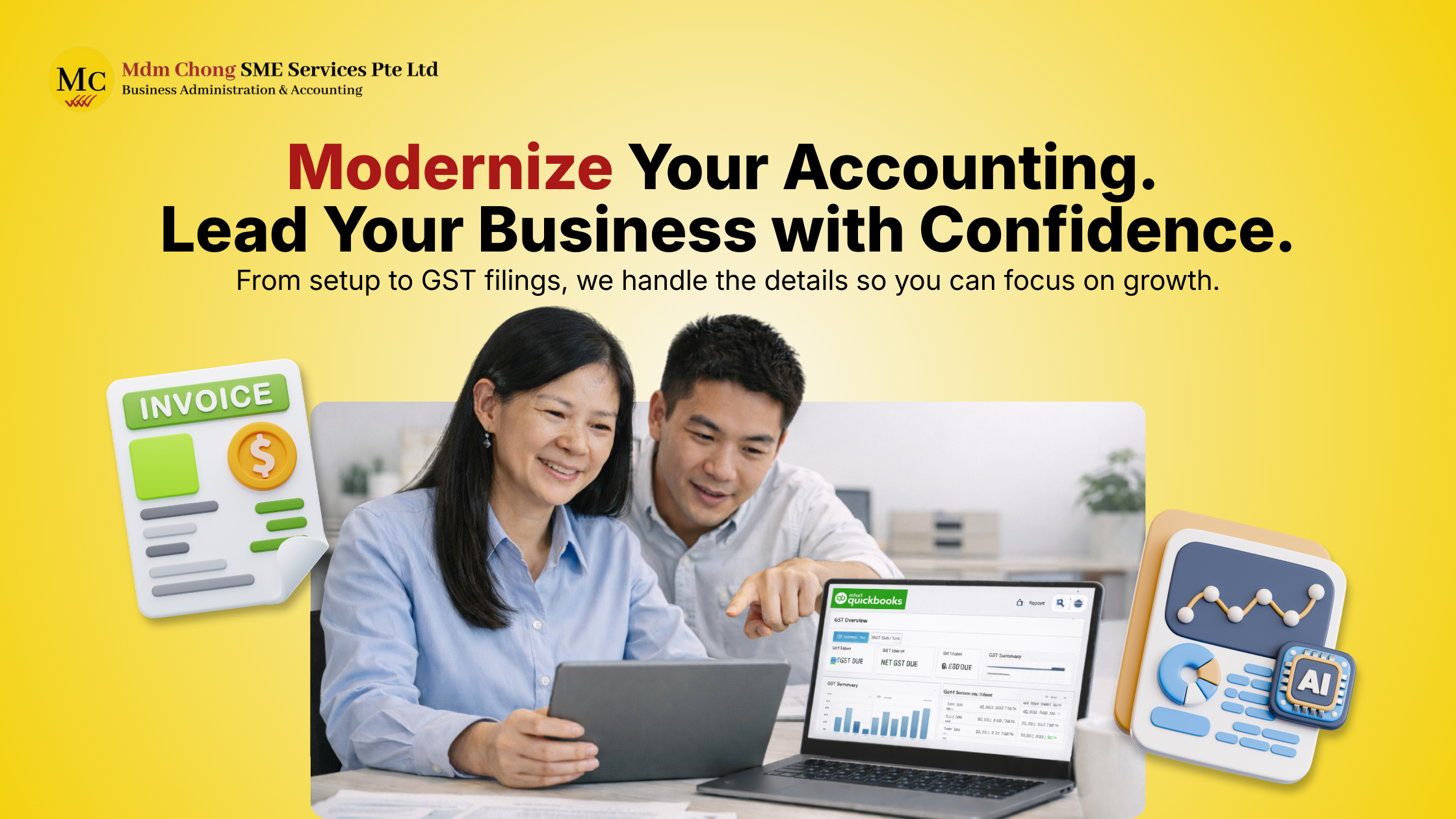
Choosing the right software is only the first step; setting it up for success is where the real value lies. Our firm specializes in end-to-end QuickBooks solutions tailored specifically for the Singapore market. From initial system migration and IRAS-compliant setup to monthly bookkeeping and GST filing, we handle the technicalities so you can lead your company with confidence.
Get In Touch
Ready to Accelerate Business Growth?
Take the complexity out of your business operations. Speak with Mdm Chong today.