
The Ultimate 2026 Guide:
How to Reduce Income Tax in Singapore
(CPF vs. SRS)
As we navigate the fiscal landscape of 2026, many Singaporeans are finding their tax bills unexpectedly higher due to the lack of an automatic personal tax rebate.
1. Understanding the $80,000 “Invisible Wall”
Before you transfer a single dollar into your SRS or CPF, you must check your proximity to the $80,000 personal income tax relief cap. This cap is the sum of all your reliefs, including:
- Earned Income Relief
- CPF Mandatory Contributions (Employee portion)
- Working Mother’s Child Relief (WMCR)
- NSman/Parent/Handicapped Reliefs
- CPF & SRS Top-ups
The Strategy: If your existing reliefs (like WMCR and mandatory CPF) already total $75,000, adding $15,300 to your SRS will only net you $5,000 in actual tax relief. The remaining $10,300 is “wasted” from a tax perspective. Always calculate your “available gap” before committing cash.
2. Deep Dive: CPF Cash Top-Ups (RSTU Scheme)
The Retirement Sum Topping-Up (RSTU) scheme remains a cornerstone for tax optimization. In 2026, you can claim up to $16,000 in tax relief through cash top-ups.
The “Self” Bucket ($8,000)
You can top up your Special Account (SA) if you are below age 55, or your Retirement Account (RA) if you are 55 and above.
- Pro Tip for 2026: Prioritize your MediSave Account (MA). It earns the same 4% interest as the SA but provides a safety net for hospitalisation and approved medical insurance (Integrated Shields). Once your MA hits the Basic Healthcare Sum (BHS), further top-ups flow into your SA/RA anyway.
The “Family” Bucket ($8,000)
You can claim another $8,000 by topping up the accounts of your:
- Parents or Parents-in-law
- Grandparents or Grandparents-in-law
- Spouse or Siblings (provided their 2025 annual income did not exceed $4,000)
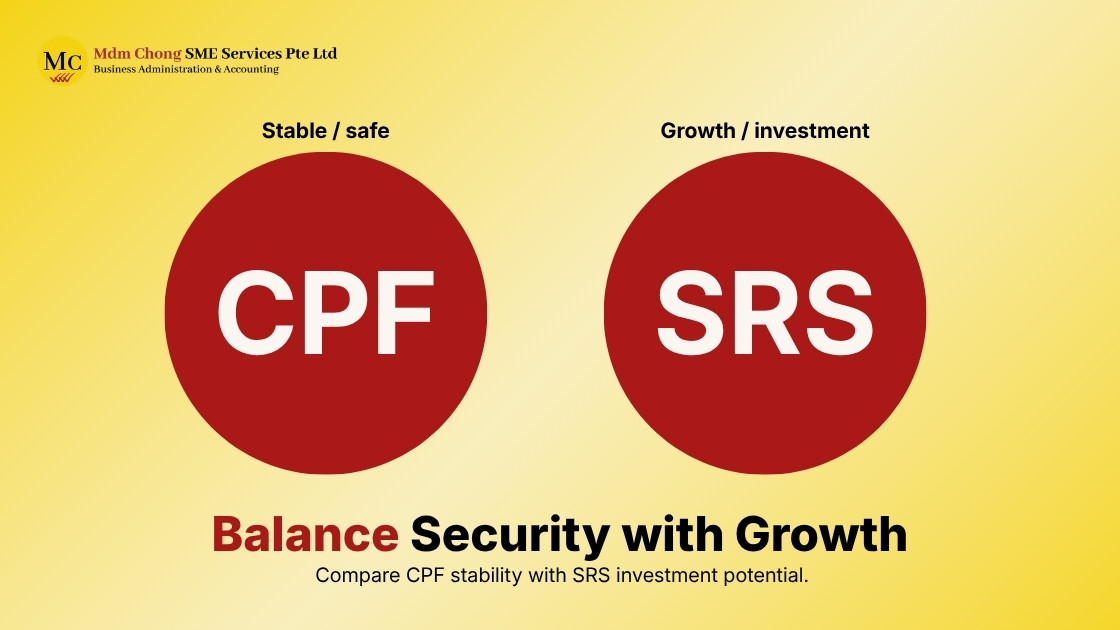
3. The SRS Strategy: The “High Earner’s” Best Friend
The Supplementary Retirement Scheme (SRS) is a voluntary scheme to complement your CPF. Unlike CPF, which is managed by the government, SRS is managed by you.
Why SRS is Powerful in 2026:
Every dollar contributed to your SRS reduces your taxable income by a dollar.
- Contribution Limits: $15,300 for Singaporeans/PRs and $35,700 for Foreigners.
- The Foreigner Advantage: Since foreigners do not have mandatory CPF, the SRS is their primary tool to avoid the highest tax brackets.
The Investment Rule: Do not leave your SRS in cash! It earns a measly 0.05%. To truly optimize contributions to retirement savings, invest your SRS funds into low-cost ETFs, REITs, or annuities to beat inflation.
4. CPF Cash Top-Up vs. SRS: A 2026 Comparison
| Feature | CPF Cash Top-Up (RSTU) | SRS Contribution |
|---|---|---|
| Max Tax Relief | Up to $16,000 | Up to $15,300 (Local) / $35,700 (Foreigner) |
| Returns | Guaranteed 4% p.a. | Market-dependent (Investment required) |
| Tax Upon Withdrawal | Tax-Free | 50% Taxable (after statutory retirement age) |
| Liquidity | Very Low (Locked until 55/65) | Medium (Can withdraw anytime with 5% penalty) |
5. Advanced 2026 Tactic: The IPC “Cap-Breaker”
What happens if you’ve hit the $80,000 relief cap but still face a massive tax bill?
Donations to Institutions of a Public Character (IPCs). In 2026, the government continues to support the charity sector with a 250% tax deduction for qualifying donations.
- The Math: A $10,000 donation creates a $25,000 deduction.
The Loophole: Donations are one of the few deductions that do not count toward the $80,000 relief cap. This is the final move for high-net-worth individuals to drop their tax bracket after maxing out CPF and SRS.
Conclusion: Small Moves, Massive Gains
Tax planning in Singapore isn’t about finding “loopholes”, it’s about the efficient allocation of your capital. Now that you know how to reduce income tax Singapore 2026 style, the next step is implementation. By automating your SRS and CPF top-ups early, you benefit from compounding interest and avoid the stress of a surprise bill in April 2027.
At Mdm Chong SME Services, we specialize in the “Big Picture.” We don’t just look at your personal income; we analyze how your business’s 40% Corporate Income Tax (CIT) Rebate and your personal retirement goals can work in harmony.
Ready to Optimize Your 2026 Tax Position?
Don’t guess your tax bracket. Let us do the heavy lifting. We can run a full “Tax vs. Savings Simulation“ to show you exactly how much you can save before the 2026 window closes.