
Strategic Guide:
Maximizing Personal Income Tax Savings in Singapore (2026)
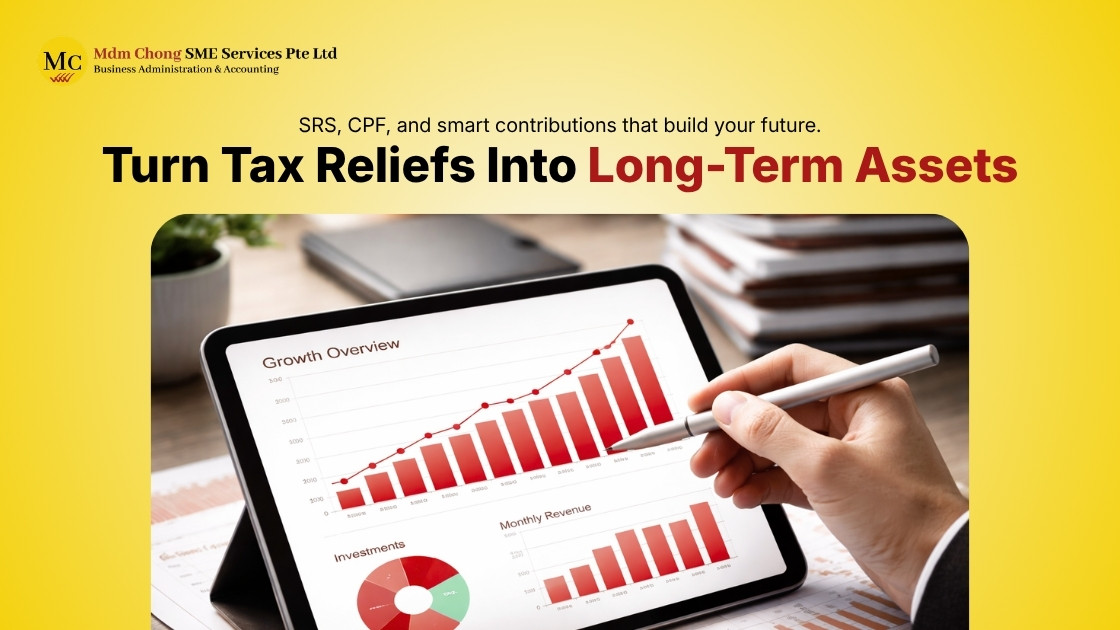
In 2026, Singapore’s personal income tax system remains progressive. The more you earn, the higher your tax bracket. However, the government offers many reliefs and deductions. These encourage retirement planning, filial piety, and lifelong learning.
For high-earning professionals and business owners, the goal is simple. Reduce chargeable income using the $80,000 relief cap.
1. The “Big Three” Wealth-Building Reliefs
These are the most effective strategies because they don’t just reduce your tax; they build your personal net worth at the same time.
A. Supplementary Retirement Scheme (SRS)
The SRS complements your CPF. Every dollar you contribute reduces your taxable income. The cap is $15,300 for Singaporeans and PRs, and $35,700 for foreigners.
Pro Tip: In 2026, with the markets favoring AI and green energy, investing your SRS funds rather than leaving them in the 0.05% interest account is crucial for long-term growth.
B. CPF Cash Top-Ups (RSTU Scheme)
By topping up your own Special/Retirement Account or those of your family members (parents, spouse, siblings), you can enjoy tax relief of up to $16,000 per year ($8,000 for yourself and $8,000 for loved ones).
2026 Update: Platform workers now have enhanced tax deduction options for CPF top-ups made by their operators, a key change from Budget 2026.
C. Voluntary MediSave Contributions
If you are self-employed or a business owner, consider voluntary MediSave contributions. They support healthcare needs and reduce your taxable trade income.
2. Leveraging Family-Related Reliefs
Notably, Singapore emphasizes filial piety and support for the sandwich generation.
- Parent Relief: You can claim up to $9,000 if you stay with a dependent parent (aged 55+) or $5,500 if they live elsewhere.
Constraint: The parent’s annual income must not exceed $8,000 (raised from $4,000 in recent budgets). - Qualifying Child Relief (QCR): A claim of $4,000 per child.
- Working Mother’s Child Relief (WMCR): For children who are Singapore Citizens, working mothers receive a fixed dollar relief (e.g., $8,000 for the 1st child, $10,000 for the 2nd) rather than a percentage of income, making it more equitable for middle-income earners.

3. The “Multiplier” Strategy: Charitable Giving
Donations to an IPC give a 250% tax deduction. For example, a $1,000 donation removes $2,500 from your taxable income.
- Budget 2026 Note: The 250% deduction rate has been extended through to 31 December 2029.
- Overseas Humanitarian Assistance Scheme (OHAS): New for 2026, individual donors can now claim a 100% tax deduction for qualifying cash donations to approved overseas emergency causes (capped at 40% of statutory income).
4. Upskilling & Professional Expenses
- Course Fees Relief: Claim up to $5,500 for fees paid for courses, seminars, or exams relevant to your current trade or that lead to a recognized qualification.
- Employment Expenses: If you work from home (WFH) and your employer does not reimburse your incremental utility or Wi-Fi bills, these can be claimed as a deduction against your employment income.
Summary Checklist for Tax Season 2026
- Check your Relief Cap: Ensure your total claims do not exceed $80,000.
- Verify Resident Status: Ensure you meet the 183-day rule to be taxed at resident rates.
- Deadline: File by 18 April 2026 (e-filing) to avoid late penalties.
- No-Filing Service (NFS): If you received a letter from IRAS saying you are under NFS, simply verify your details on the MyTax Portal without filing a new return.

Conclusion: Proactive Planning Beats Reactive Filing
The best time to reduce your 2026 tax was in 2025, as many contributions like SRS and CPF top-ups must be made by 31 December of the preceding year. However, the work doesn’t end there, ensuring you accurately claim every eligible family relief, course fee deduction, and the latest Budget 2026 rebates during the current filing window is the best way to protect your take-home pay today.
Don’t leave your tax savings to chance or settle for “auto-inclusion” defaults that might miss complex deductions. At 钟会计企业服务, we provide expert Personal Tax Advisory to help high-net-worth individuals and business owners navigate the $80,000 relief cap and maximize their wealth. Contact us today for a tax resonance check and ensure you aren’t paying a cent more than you legally owe.